
Farmington Hills Previous Residents by Era
Each source answers a different part of the address question. The deed trail is strongest for recorded transfers and the legal description. Directories and census schedules add dated household clues. Newspapers, probate, and local collections can explain a change of name or an estate transfer. The coverage below is local or state-supported, and the stated gaps matter as much as the dates.
| Source | Years It Covers | Where Held | What It Shows |
|---|---|---|---|
| Oakland computerized land index | January 1, 1964–current | Oakland Super Index and Register of Deeds | Searchable parties, documents, legal descriptions, and images or copies |
| Oakland manual and deed books | 1800s–1963, exact series varies | Register of Deeds retention and manual tract files | Earlier chain, acreage, subdivision, condominium, and legal-description records |
| Oakland marriage and death genealogy | Marriage online about 1868+, counter to 1827; death online from 1900, counter to 1867 | Oakland County Clerk | People and dates that can explain transfers and heirs |
| Farmington directory scans and holdings | Named 1939–1950; broader Farmington and Farmington Hills issues 1939–2001, scattered | FCL Heritage Collection | Dated household, telephone, and local-place snapshots |
| Bresser or criss-cross directories | Library of Michigan general series late 1960s onward; exact local years not located | Library of Michigan and possible FCL holdings | Address-order household and first-listed or move notation |
| Farmington Observer | Scattered 1888–1910; microfilm 1910–2011; digital and keyword material 1888–2003 and 2003–current quarter | FCL Heritage and digital archive | Obituaries, sale notices, civic names, and address clues |
| Federal census | Public through 1950 under the 72-year rule | NARA and FCL database access | Household, person, and place pairing at decade points |
| Archives of Michigan probate | Case files and calendars 1820/1822–1971 | Lansing Archives | Estate, heirs, fiduciary, property, and final-address clues |
| Farmington Hills permits | Active records; exact online start not located | City Building Department and FOIA | Construction or change dates and retained plan attachments |
| Sanborn maps | Farmington, March 1926, four sheets; no Farmington Hills series confirmed | Library of Congress and Library of Michigan | Building footprint, use, address, and neighborhood form |
Start with the source closest to the known date. For a recent transfer, begin with the county index. For a mid-century household question, test the named directory scans and newspaper run. For a much older tract, expect a manual-record handoff and use a legal description rather than a modern street number alone.
Farmington Hills Address Records
The current owner is the first link, not the first resident. Search the Farmington Hills municipal record by street address, owner name, or parcel number, then save the property’s PIN, legal description, and situs address. A situs is the physical property address. The mailing address can be somewhere else, which is a normal tax-record difference and not evidence of who occupied the property.
The record path is: address → municipal parcel and PIN → county map → recorded document → historical directory. The Farmington Hills BS&A Online portal supplies the municipal search, while Oakland Property Gateway adds a parcel map, aerials, property details, and available reports. Preserve the original PIN format as well as a no-dash version for tax searching.
Note: The county map establishes parcel geometry and related geographic layers, while the recorded instrument establishes a documented transfer; neither produces a full household roster.
Farmington Hills Deed Records Backward
Oakland County’s deed chain works backward from the latest known conveyance. The Oakland County Super Index provides the computer-indexed layer beginning January 1, 1964. Search using the current recorded owner, grantee, address term, PIN, or legal description, then read the indexed document and its first-page image when available. A mortgage, discharge, foreclosure, estate paper, or release can change the names in a result without being an ordinary transfer, so confirm each party’s role.
- Save the current municipal owner-of-record, PIN, situs, and legal description before starting the recorded-document search.
- Find the deed that conveyed the property to the current owner. Record its document number, recording date, grantor, grantee, and legal description.
- Search the same legal description or the prior grantor as the next grantee, rather than relying only on a street number that may have changed.
- Repeat the process backward, preserving the type of every instrument and comparing each legal description to the earlier record.
- At the 1964 computer-index boundary, move to the Grantor/Grantee Unit, Tract Index, manual deed books, plats, microfilm, and retention records.
- Grantor and grantee
- The grantor transfers an interest in an instrument; the grantee receives it. Their roles must be read from the document type, not assumed from the name alone.
- Chain of title
- The sequence of recorded transfers and related instruments used to follow a property’s legal ownership history.
- Legal description
- The lot, block, subdivision, condominium, metes-and-bounds, or other property description carried through records. It is often more stable than an address.
Farmington Hills 1964 Records Handoff
The 1964 cutoff is a practical research number, not the start of Oakland land history. Computerized property records begin on January 1, 1964, while manual and deed-book material reaches into the 1800s. When a Super Index result stops at that boundary, continue with the same legal description at the Register of Deeds rather than ending the search. The Tract Index keeps manual material for title-chain work and a complete index of platted subdivisions.
Ask the Oakland County Tract Index desk for the last deed, date, or price where available, as well as the relevant plat or legal-description route. Its counter is the documented manual fallback for older acreage, subdivision, and condominium research. Oakland also moved Acreage Book Search into Super Index on July 1, 2026, so the legal-description lead may now begin in the same online system before the manual handoff.
Farmington Hills Township Records
Address continuity has a local history problem. Farmington Hills incorporated in 1973 from the remaining Farmington Township and the former Wood Creek Farms and Quakertown areas. Wood Creek Farms became a village in 1957 and Quakertown in 1959. Older deeds, directories, census records, and newspapers may therefore use Farmington Township, Farmington City, or another period postal label for an address that now falls in Farmington Hills.
The original Farmington Township Hall on Grand River was destroyed in a major 1870s fire, and many early records were lost. That loss makes the combination of deed, tax, church, newspaper, census, and directory material especially important. Compare the parcel PIN or legal description with contemporaneous road names, and retain the historical place label in notes rather than rewriting an older source under the modern city name.
Farmington Hills Past Residents
Recorded ownership is only one layer of a former-address question. To trace past residents, pair each transfer with a dated directory or census source. FCL’s named Farmington directory scans cover 1939 through 1950, and its broader Farmington and Farmington Hills city, telephone, and Polk holdings are scattered from 1939 through 2001. The local volumes are described in more detail on the Farmington Hills city directory page, while the address-history work stays focused on the order of evidence here.
- Place the deed recording date on a working timeline, leaving it labeled as a transfer date rather than an occupancy date.
- Check the nearest available FCL directory edition for the address, period place name, and listed household clue.
- Compare the next available directory and the relevant public census decade, looking for matching street, family, and locality details.
- Use the FCL obituary or surname index and Farmington Observer when a disappearance, death, estate, or family relationship needs a dated follow-up.
Federal census schedules through 1950 are public under the 72-year rule. They are decade snapshots, not annual records. A directory absence can reflect an unlisted telephone, a changed spelling, a place-label change, or a collection gap. Check the original source and at least one other dated record before describing a household transition.
Lawful use. Use Farmington Hills address history for personal, lawful research, family history, estate questions, or property curiosity. Do not use names or records to stalk, harass, or harm anyone.
Farmington Hills Permit Records
Permits can date a physical change without proving who lived at an address. Farmington Hills provides active building records through BS&A, where an address or building-record number can lead to a permit record. A retained application or plan may help establish when work was proposed, approved, or completed. It should be kept separate from a deed and a directory listing because each records a different event.
For a closed file, old plan, or record that the online service does not expose, use the Farmington Hills Building Department and the city’s FOIA process with the exact address, parcel, and date range. The city can provide an existing record or explain an exemption; it does not have to create a history list that was never maintained.
Note: A permit date can support construction or remodeling chronology, but it is not a substitute for recorded ownership or a dated household listing.
Farmington Hills Sanborn Records
Sanborn fire-insurance maps are useful only within their confirmed geography. The documented local item is a March 1926, four-sheet set for Farmington, Oakland County. It can help with the historic Farmington core by showing building footprint, use, address, and neighborhood form. It is not a map series for all of Farmington Hills, and no official Farmington Hills-specific Sanborn run was located.
The Library of Congress Sanborn research guide explains how to locate and interpret this map material.
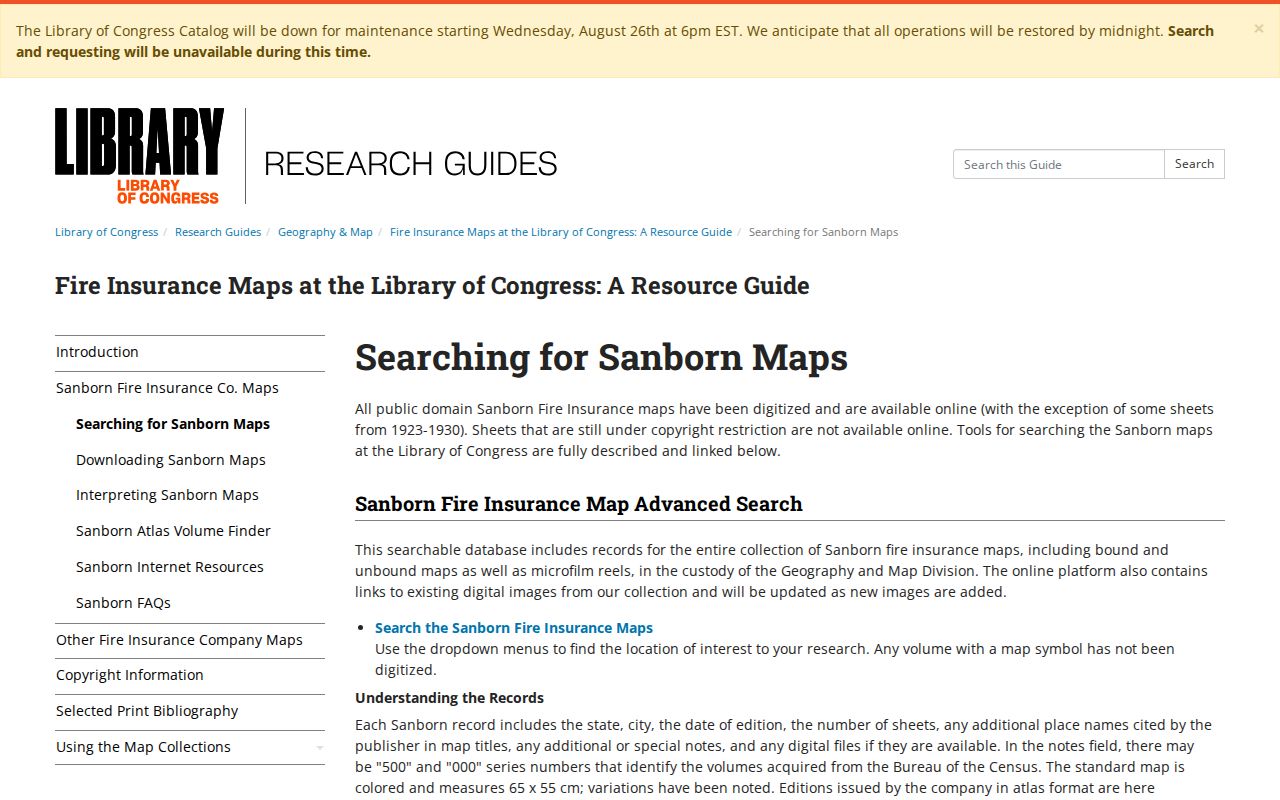
Use the 1926 Farmington item as a building and place clue, then bridge it to the right parcel, legal description, directory edition, or deed. A map can date the built environment, but it does not establish an ownership or household relationship by itself.
Farmington Hills History Records
When the online chain becomes thin, the two named local fallbacks are the FCL Heritage Collection and the Oakland History Center. FCL has vertical files, photographs, clippings, local monographs, family records, and directory runs. The Oakland County Historical Society research library at Pine Grove provides advice, research services, digitization, and free copies where available. Give either desk the exact address, owner surname, approximate period, and parcel or legal description to make the request useful.
For an estate clue, Oakland probate and the FCL obituary index can help connect a decedent, heirs, and a former address. For older county material, the Archives of Michigan Oakland guide, manual land records, and the local-history collections are better fallbacks than assuming an unverified online series exists. Preserve the source, access channel, and date for each result so later work can distinguish evidence from a lead.