
Farmington Hills Directory Shelf
The Farmington Community Library Heritage Collection is at the Farmington Hills location only. It combines local scans with physical Farmington and Farmington Hills city, telephone, and Polk directories. The named online runs provide useful checkpoints, while the physical shelf fills some later gaps. The collection does not publish one complete issue-by-issue inventory, so confirm a desired year with the library desk before treating a gap as a missing household.
| Collection | Years | Where Held | Access |
|---|---|---|---|
| George Cotter Farmington City/Township directories | 1939–1940; 1941–1942; 1945–1946 | FCL Heritage Collection | Online scans |
| Michigan Bell Farmington City/Township directories | January 1945, 1946, and 1947 | FCL Heritage Collection | Online scans |
| Farmington local directory and telephone titles | 1948; 1949 White and Yellow Pages; January 1949 Longacre; Mayfair 1949–1950; 1950 White Pages and Classified | FCL Heritage Collection | Online and local collection |
| Farmington and Farmington Hills city, telephone, and Polk directories | 1939–2001, scattered issues | FCL Heritage Collection | Physical collection, confirm issue with desk |
| Bresser or criss-cross county directories | Michigan collection generally late 1960s onward; exact local run not located | Library of Michigan and possible FCL holdings | Catalog and desk inquiry |
Polk material can contain surname, street, telephone, and classified sections. The state library describes later Bresser or criss-cross volumes as address-order tools that may also note the listed household head, phone number, first-listed year, and moves within the area. No exact Bresser run for Farmington Hills was located, so request the cataloged volumes rather than assuming that every year is on a local shelf.
Farmington Hills Directory Scans
The digitized telephone-directory shelf is a practical first stop for the named Farmington editions. These are scan-style volumes, not a uniform database. Open the relevant issue, use the browser’s Ctrl+F command for a surname or street term, then inspect the page image and the cover or title page. OCR and searchability can vary across pages, especially in older type.
The Farmington searchable telephone directories show the local scan shelf used for this kind of year-by-year check.
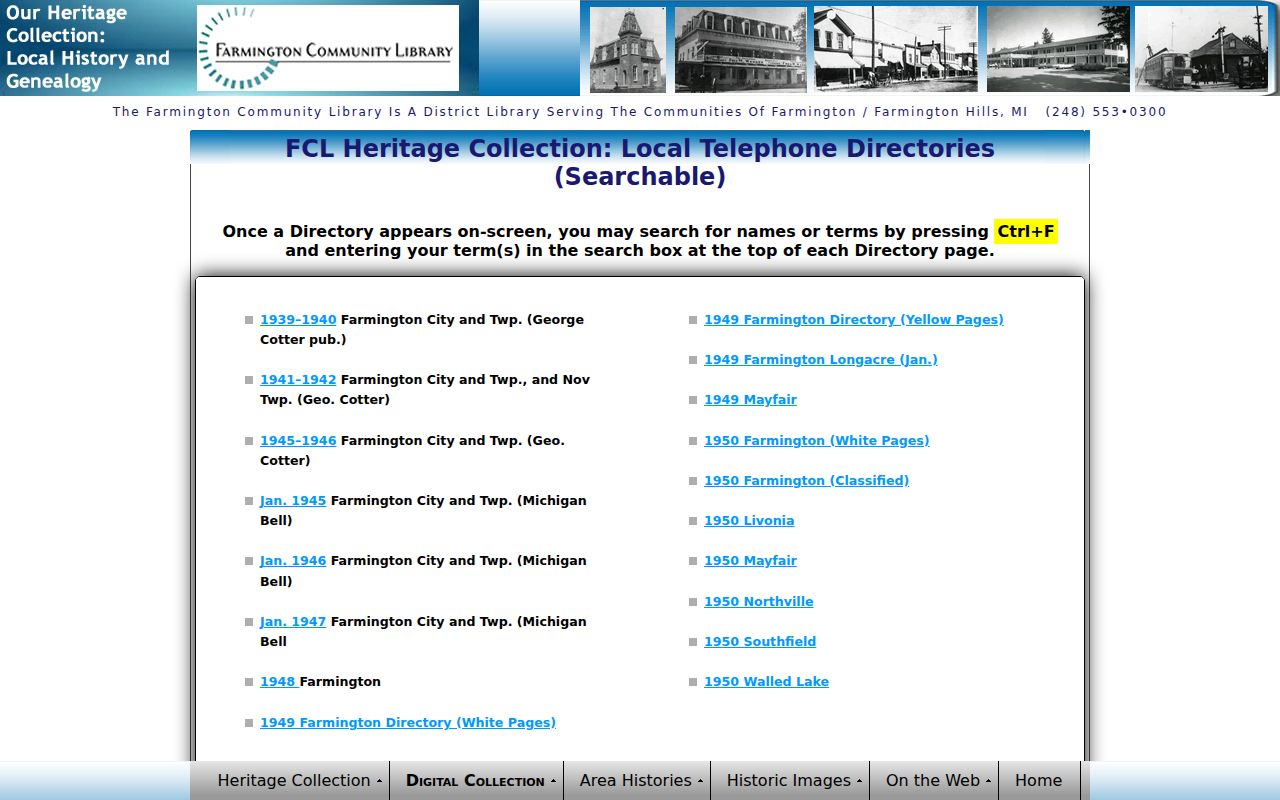
Each scan should be recorded with its publisher, edition date, and page number because it does not have a permanent database-row identifier. A missing result may reflect an unlisted telephone, the directory’s scope, a spelling variation, or a scan-search limitation.
Note: The local scans provide named checkpoints, but the Heritage Collection’s broader 1939–2001 holdings are scattered rather than a proven annual series.
Farmington Hills Directory Heritage
A directory entry becomes more useful when it is paired with the Heritage Collection’s other local indexes. The online obituary index can return a last name, first name, Soundex code, death date that may be approximate, source, obituary date, and page number. The surname index draws from church records, newspapers, family-group sheets, land conveyances, marriage notices, obituaries, funeral-home records, and more. Both are leads that require checking the original item.
The Farmington online genealogical indexes describe these digitized local search tools.
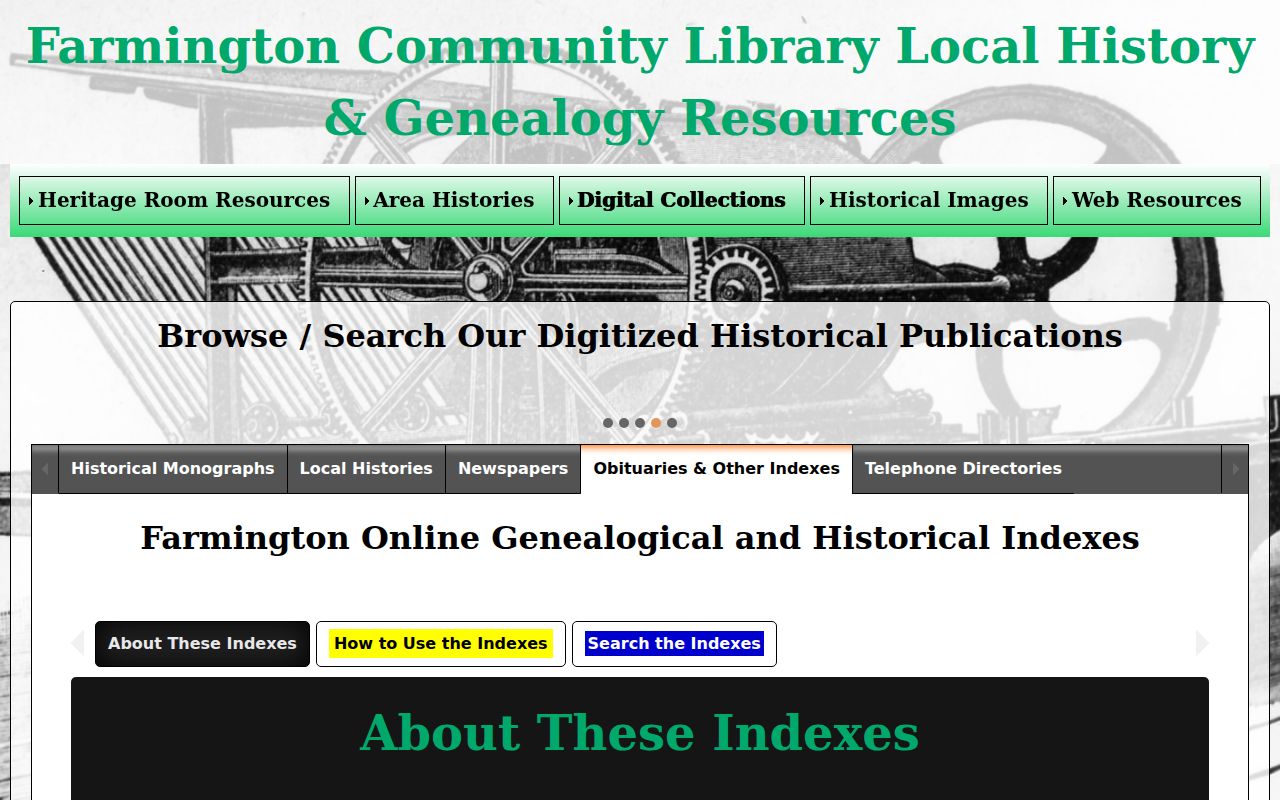
The library also lists Ancestry Library Edition for in-library use and MyHeritage for in-library or remote use with a valid FCL card. Those services can help pair a directory interval with published census material, but the directory scan remains the evidence for its own date.
Farmington Hills Newspaper Trail
When a household disappears between editions, the Farmington Observer collection can supply the next dated clue. Local coverage includes scattered issues from 1888 through 1910 and Observer microfilm from 1910 through 2011. The digital project lightly indexes broader runs from 1888 through 2003; Observer scans from July 2003 through the most recent previous quarter are keyword searchable, with an optional year filter. The first digitization project also reports limited or missing 1960–1962 and 1987 material.
The Farmington newspaper search is the documented route to those scans, microfilm, and search cautions.
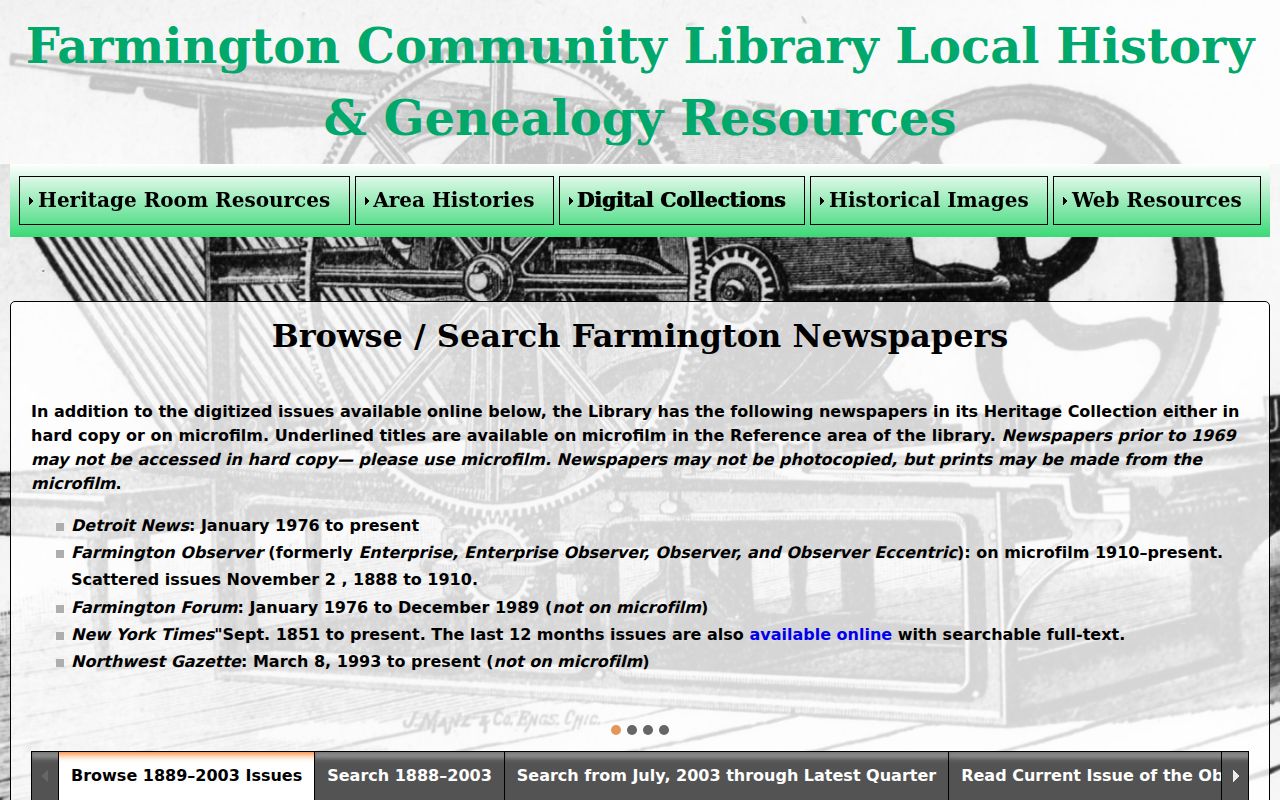
An obituary, sale notice, wedding notice, civic mention, or land-conveyance reference can help explain a move or family connection. Volunteer-made indexes and newspaper text can contain errors, so compare the result to the underlying page before using it as a conclusion.
Note: Pre-1969 local newspapers are generally microfilm-only, and the collection says newspapers may not be photocopied although microfilm prints can be made.
Reading a Farmington Hills City Directory
Read an entry as a time-stamped listing, not as a full household census. The January 1947 Michigan Bell Farmington City/Township scan is a useful local example of format. Its white-pages style normally gives a printed surname or name, often the principal household listing, plus a street address and local city or township label. A telephone exchange or number may appear. Separate business or classified pages provide different context and should not be treated as proof of a household connection.
| Printed name | Usually the principal telephone listing; preserve spelling exactly as shown. |
|---|---|
| Street address | A period address paired with the Farmington-area city or township label. |
| Telephone detail | An exchange or number where the edition includes one. |
| Edition evidence | Publisher, edition date, page number, and scan page for a traceable citation. |
| Directory context | Separate surname, street, phone, or classified sections can answer different questions. |
- Criss-cross directory
- An address-order directory that runs by street and house number rather than surname. Library of Michigan material describes this later county-directory format, but a precise Farmington Hills run was not located.
- Householder listing
- The principal person printed for a household or telephone entry. It does not establish every person who was present at that address.
- Abbreviation key
- The volume’s explanation of short forms. Photograph or note it before interpreting labels that are specific to one publisher.
Farmington Hills Township Labels
Older city-directory research crosses more than one municipal name. Wood Creek Farms became a village in 1957, Quakertown in 1959, and Farmington Hills incorporated in 1973 from the remaining Farmington Township and those former areas. Earlier entries can therefore be filed under Farmington Township, Farmington, or another period postal label even when the modern address is in Farmington Hills.
This continuity problem matters because the original Farmington Township Hall on Grand River was destroyed in a major 1870s fire, with many early records lost. Directories, deeds, tax material, church records, newspapers, and census schedules take on added value when a township file does not survive. Test the period place name and the modern city name, then compare road names, a parcel description, or another source before joining the records.
The Library of Michigan city-directory guide explains the broader Polk and Bresser collection, including print, rare-item, microfilm, and online access routes.
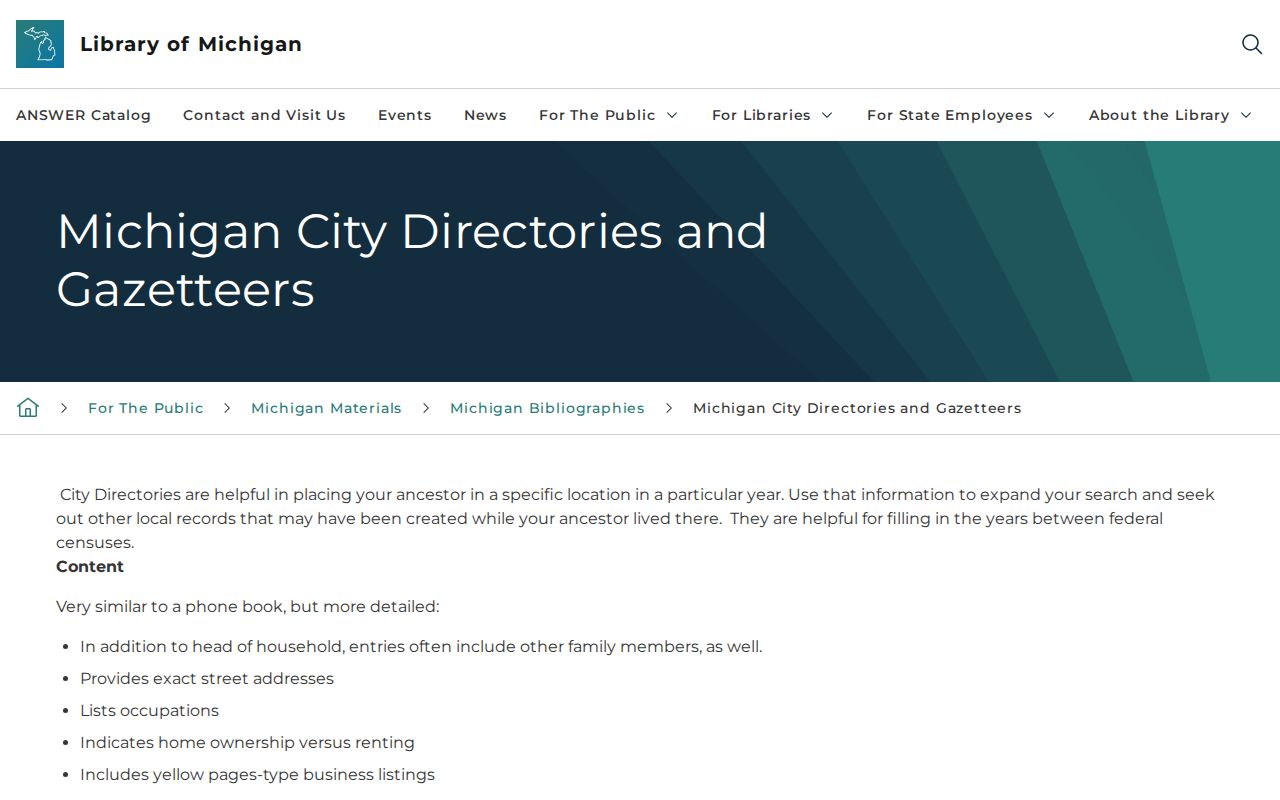
At the Library of Michigan, print directories are shelved on second-floor South alphabetically by city or county; rare items use call-number order, and microfilm or fiche is in the second-floor South Microfilm Room. Its online holdings are available through Ancestry Library Edition and HeritageQuest.
Farmington Hills Local History Help
For a difficult address or surname, request materials as a collection question instead of asking for a single all-purpose directory. FCL has vertical files about Farmington Township, photographs, local monographs, newspaper clippings, family records, yearbooks, the Robert B. Cook Collection, and Heeney-Sundquist Funeral Home files. The funeral-home papers include 15 volumes of photocopied death certificates from 1950–1992 with an every-name index. Farmington Township high-school yearbooks begin in 1923, with scattered coverage.
The Oakland History Center at Pine Grove is another documented place-history fallback.
The Oakland County Historical Society research library, at 405 Cesar E. Chavez in Pontiac, offers research help, digitization, and free copies where available. Its listed hours are typically Tuesday through Thursday, 11 to 4, and its office phone is 248-338-6732. For Farmington Hills material, give the address, surname, and approximate period so staff can direct the request to the right collection.
Tracing Farmington Hills City Directories
Use city directories to build a sequence, not to force a yearly story where the collection has gaps. Start with the closest named edition and retain a citation for each result. Pair an address change with a census decade, a newspaper search, or a probate and obituary lead. Federal census schedules through 1950 are public under the 72-year rule, but they are decade snapshots. Intervening directories help show when a name or address changes without claiming an exact annual move date.
- Find the earliest available Farmington or Farmington Township entry for the name, and save the edition date, page, spelling, and address.
- Check the next available local directory edition. Record the address change, a telephone detail, or an absence without assuming why the entry changed.
- Where an address is known, request an appropriate street-order or criss-cross volume from the Library of Michigan or FCL, because the exact local Bresser run is not confirmed.
- Pair the sequence with the relevant public census decade and compare household names, place labels, and street information.
- Use the FCL obituary and surname indexes, newspaper microfilm, or Oakland probate records when a death, estate, or family link may explain the next change.
A directory disappearance can mean a move, an unlisted telephone, a changed place label, or a gap in the surviving run. Check the original scan and a second record type before treating absence as evidence. When a modern parcel is the starting point, the current address-record path belongs with the Farmington Hills street directory rather than the historic shelf.
Farmington Hills Directory Gaps
The Farmington Hills collection is unusually rich, yet it has real limits. A complete first-to-last printed Farmington Hills directory run was not verified. Nor was a local Bresser inventory or a citywide historical voter-register series. Treat a shelf, scan, or index as a route to an item, not proof that no other record exists. The best fallback chain is the FCL local-history desk, the Library of Michigan, Oakland History Center, Archives of Michigan, and the relevant city or county custodian.
Note: Preserve the source title, period place label, edition date, page, and access route for every Farmington Hills city-directory finding so later comparisons remain possible.